A Letter from the Rock: An Introduction to the Epistles of Peter
For believers walking through loss, opposition, discouragement, or uncertainty, Peter’s letters speak with a steady and compassionate voice of hope. He reminds us of our true identity as God’s own and anchors us in the living hope secured in Christ. This four-part series begins with an introduction, opening a gentle pathway into the themes and truths of 1 and 2 Peter.
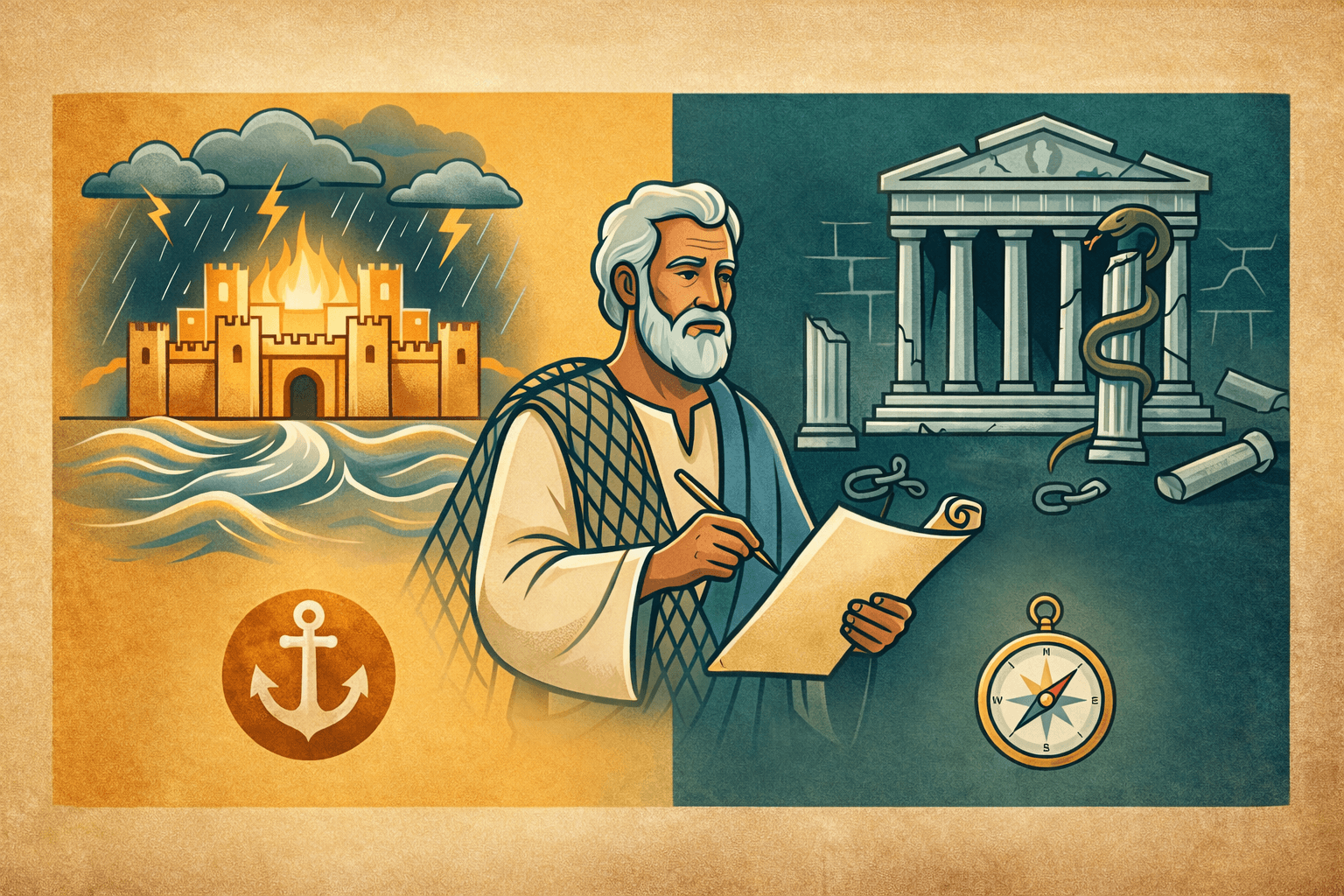
In this introduction, you will explore:
- Who Peter was — his faith, failures, and transformation
- Why he wrote these letters and to whom
- The historical pressures believers faced
- The central themes of suffering, identity, and living hope
- How these ancient letters speak into our present struggles
Among the books of Scripture, the Epistles of Peter hold a unique and tender place. They are not abstract theological writings, but deeply personal and urgent letters shaped by a man who walked closely with Jesus — a man who knew the boldness of faith, the pain of public failure, and the quiet miracle of being restored by grace.
It is this lived experience that gives his words a rare honesty and a gentle authority. For believers navigating a confusing, complex, and often hostile world, his reflections on hope, suffering, and steadfast faith continue to speak with a surprising freshness.
Meeting the Messenger: Peter’s Life & Story
Have you ever felt like your past failures disqualify you from serving God? Before we can truly hear the message in 1 and 2 Peter, we need to meet the messenger—a man whose life became a testimony to God’s patient and transforming love. His personal journey forms the living backdrop of his letters, giving weight to every word he writes about hope, endurance, and faithfulness.
FROM FISHERMAN TO CHURCH PILLAR
Before he was an apostle, Peter was Simon — a fisherman on the Sea of Galilee. His days were shaped by physical labour, uncertainty, and life under Roman rule. Yet when he encountered Jesus, everything began to change. Christ gently redirected Peter’s natural intensity and passion, forming him into a shepherd of God’s people.
Key aspects of Peter’s life include:
- Background: A fisherman by trade, brother of Andrew, originally named Simon son of Jonas.
- Personality: Bold and outspoken, yet impulsive and prone to stumbling. Passionate, hardworking, deeply devoted — and continually dependent on grace.
- Leadership: Often the voice among the disciples, a central figure in the early church (Acts 15), and the Spirit-filled preacher at Pentecost, where thousands came to faith (Acts 2).
- Transformation: The man who once relied on his own strength later wrote of being “born again to a living hope.” His life quietly assures us that the gospel truly changes people from the inside out.
PETER'S JOURNEY WITH JESUS
Peter’s relationship with Jesus was marked by moments of breathtaking faith and moments of heartbreaking failure. This tension is precisely what makes him so relatable — and his words so comforting.
Moments of Faith and Insight:
- His immediate response to Jesus' call to become a "fisher of men" (Matthew 4:19)
- His divine revelation and declaration that Jesus is the Messiah and the Holy One of God (Matthew 16; John 6)
- Stepping out onto the water in faith (Matthew 14)
- Being renamed Petros (the "Rock") by Jesus, a prophetic statement about his future role in the church (Matthew 16:18)
- Witnessing Jesus’ miracles, transfiguration, and resurrection
Moments of Failure and Misunderstanding:
- Rebuking Jesus for foretelling His death and resurrection (Matthew 16:22-23)
- Denying Jesus three times on the night of His arrest (Matthew 26:69-75)
- Impulsively drawing his sword and cutting off a guard's ear in the Garden of Gethsemane (John 18:10)
Crucially, Peter’s story does not end in shame. After the resurrection, Jesus met him by the sea and gently restored him, entrusting him once again with the care of His people: “Feed my sheep” (John 21:15-19). This profound experience of forgiveness and recommissioning undoubtedly shaped Peter’s ministry and permeates his letters with themes of grace, redemption, endurance, and hope.
A Church Under Pressure: The Original Audience
These letters were written to encourage scattered believers facing real pressure — social, political, and spiritual. Yet Peter does not begin with strategies, warnings, or solutions.
He begins with hope.
He gently calls believers back to what is unshakeable:
their identity in Christ and the inheritance that cannot fade.
"Blessed be the God and Father of our Lord Jesus Christ! According to his great mercy, he has caused us to be born again to a living hope through the resurrection of Jesus Christ from the dead"
(1 Peter 3)
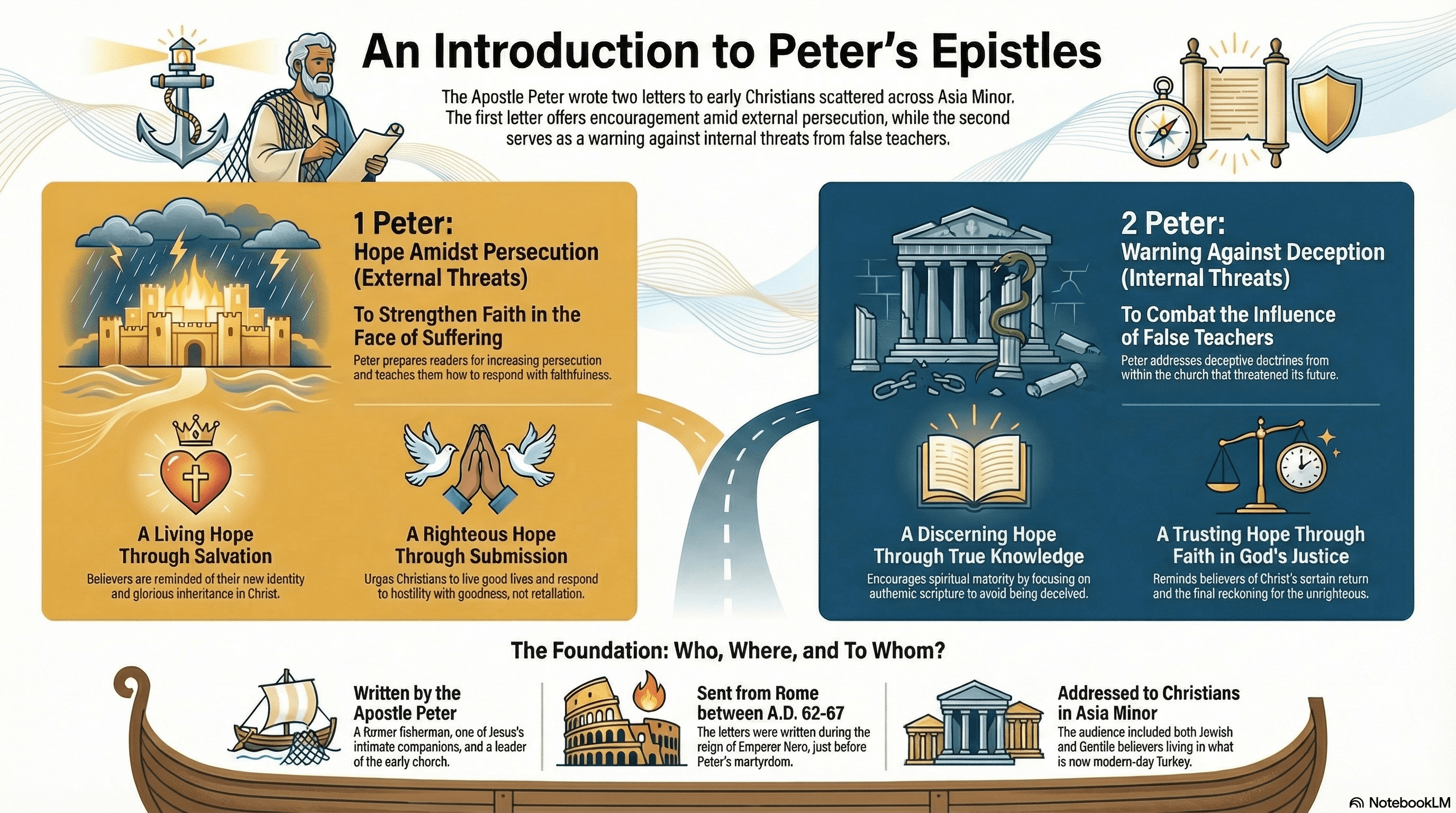
- Date of Writing: The first epistle was likely written around A.D. 62-63, with the second following shortly before Peter's death, between A.D. 64-67.
- Location: “Babylon” — widely understood as a symbolic reference to Rome.
- Audience: Christians scattered across Pontus, Galatia, Cappadocia, Asia, and Bithynia (modern-day Turkey)
- Composition: A mix of Jewish and Gentile believers (1 Peter 2:10; 4:3)
- Historical context: Peter wrote during Nero’s reign, when hostility toward Christians was escalating. After the great fire of Rome in A.D. 64, Christians were scapegoated and brutally persecuted. Peter’s first letter prepares believers for this “fiery trial,” calling them to stand firm with hope rather than fear.
“In this you rejoice, though now for a little while, if necessary, you have been grieved by various trials, so that the tested genuineness of your faith—more precious than gold that perishes though it is tested by fire—may be found to result in praise and glory and honor at the revelation of Jesus Christ.”
(1 Peter 1:6–7)
Purpose and Themes of the Epistles
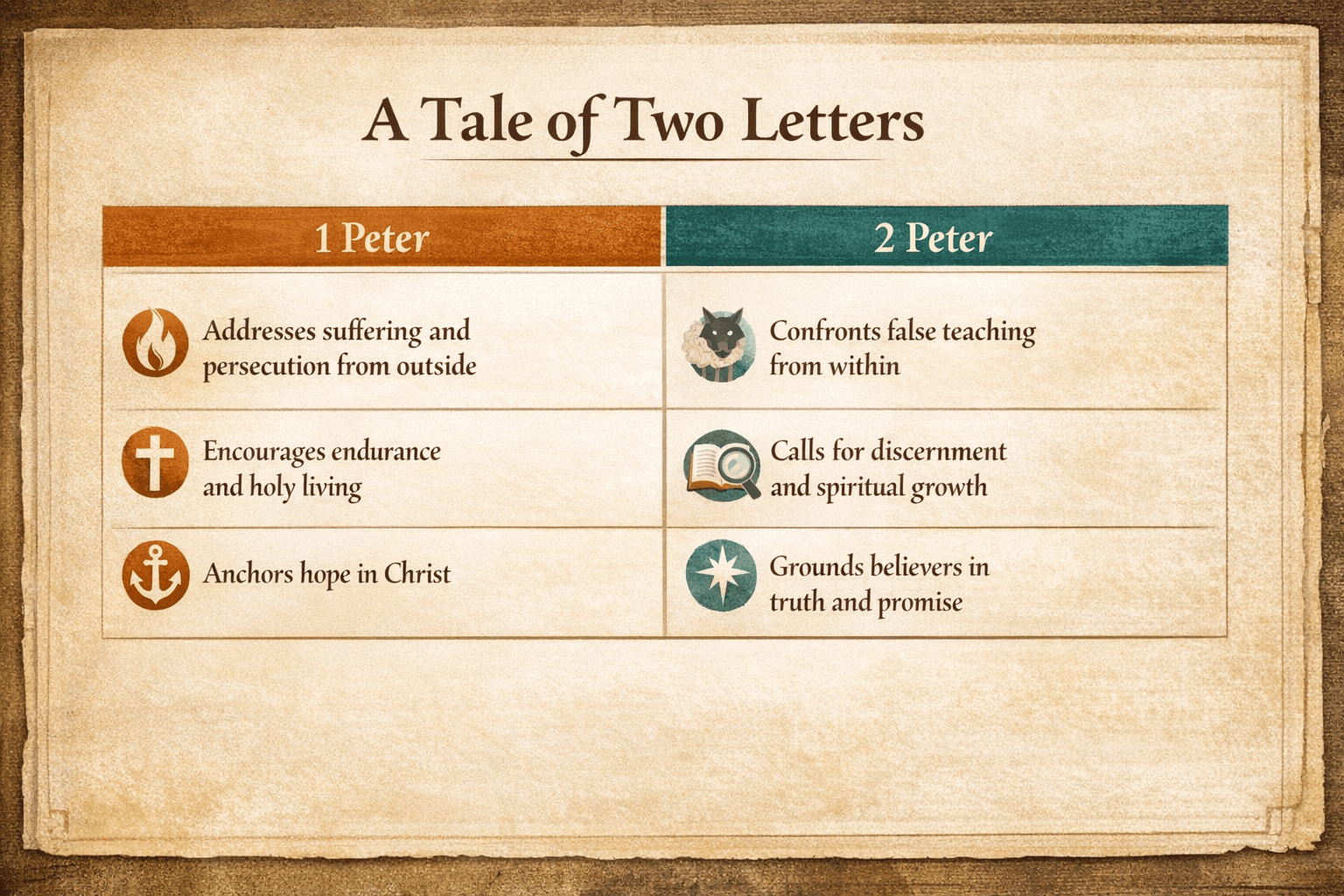
Though written close together, Peter’s two letters address different dangers faced by the church:
- 1 Peter — When suffering and opposition arise
Peter teaches believers how to stand firm with gentleness, holiness, and hope. - 2 Peter — When false teachings and confusion spread
Peter urges believers to grow in discernment, maturity, and confidence in God’s promises.
"But grow in the grace and knowledge of our Lord and Savior Jesus Christ."
(2 Peter 3:18)
Together, these letters form a steady path for believers learning to live faithfully in a world that often does not understand them.
Why These Letters Still Matter Today
When read together, 1 and 2 Peter provide a powerful and balanced framework for believers learning how to live faithfully in every age.
They are built on four foundational pillars that equip believers to stand firm against threats from both outside and within the church.
- Warning – Against persecution from outside and false teaching from within
- Encouragement – Rooted in a "living hope" and eternal inheritance "that can never perish, spoil or fade"
- Holiness & Christian Living – Faith expressed through obedient, faithfulness, perseverance, and righteous conduct. Believers are to "live such good lives among the pagans" that their conduct would bring glory to God, even in the face of a hostile world. This practical holiness is the tangible evidence of their inner transformation.
- Identity in Christ – Chosen, redeemed, and secure in God’s purposes
“You are a chosen race, a royal priesthood, a holy nation, a people for his own possession.”
(1 Peter 2:9)
Peter’s own life — from impulsive zeal to gentle shepherding — assures us that the grace he proclaims is not theoretical, but real and transformative.
Written near the end of his life, these letters reflect the maturity of a man shaped by suffering, mercy, and hope. They invite us to live with hope, holiness, and faithfulness in a broken world.
We invite you to continue this journey with us as we explore 1 Peter and 2 Peter in the series that follow.
----
To help you engage with this teaching in the way that best suits you, the above content is available in three formats:
Read the intro: PDF (Click link)
Visual Summary
Video Summary
The Epistles of Peter: Introduction
Next: A Living Hope for Alien Times (1 Peter 1 & 2)
Continue Reading

The Unbroken Thread: The Bible as One Unified Story
The Bible is often read in fragments—but it was written as one story. Across 66 books and more than 1,500 years, Scripture unfolds a single narrative of creation, brokenness, redemption, and hope. This teaching helps you see the Bible not as isolated passages, but as one coherent story that reveals God’s purpose for the world—and for us.
The Bible is often read in fragments—but it was written as one story. Across 66 books and more than 1,500 years, Scripture unfolds a single narrative of creation, brokenness, redemption, and hope. This teaching helps you see the Bible not as isolated passages, but as one coherent story that reveals God’s purpose for the world—and for us.

Living Out Our Calling in a Hostile World (1 Peter 3–5)
In Part III of our four-part journey through the Epistles of Peter, we explore how believers can respond to opposition with courage, love, and humility — turning suffering into a compelling testimony of hope in Christ.
In Part III of our four-part journey through the Epistles of Peter, we explore how believers can respond to opposition with courage, love, and humility — turning suffering into a compelling testimony of hope in Christ.

A Living Hope for Alien Times (1 Peter 1 & 2)
Part II in a four-part journey through the Epistles of Peter: In a world that often feels unfamiliar and costly to faith, Peter’s first letter reminds believers who they are, what they are called to, and how they are to live. Rooted in 1 Peter 1–2, this teaching explores our identity as God’s chosen people, our call to holy distinctiveness, and our witness as faithful exiles—anchored in a living hope that suffering cannot destroy.
Part II in a four-part journey through the Epistles of Peter: In a world that often feels unfamiliar and costly to faith, Peter’s first letter reminds believers who they are, what they are called to, and how they are to live. Rooted in 1 Peter 1–2, this teaching explores our identity as God’s chosen people, our call to holy distinctiveness, and our witness as faithful exiles—anchored in a living hope that suffering cannot destroy.